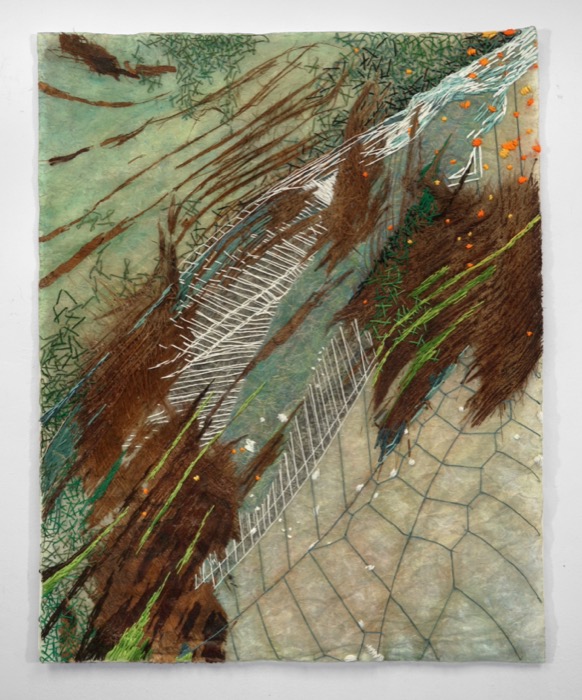

30″ x 24″ painted mulberry paper, palm tree bark, thread $5500
Artist Bio
Sherry Tseng Hill holds a Bachelor of Arts in Architecture and Art History (1980) and a Bachelor of Architecture (1982) from Rice University, Houston, Texas. After practicing architecture and raising two sons, she returned to her studio practice and completed the BLOCK Program at the Glassell School of Art, Museum of Fine Arts, Houston (2021–2023), where she now teaches.
Her work has been exhibited at The Glassell School of Art, Rice University, Fort Worth Community Arts Center, the San Antonio Art League and Museum, Discovery Green, and The Jung Center. Public collections include Rice University, Houston Endowment, and the City of Houston, for which she created a public art commission.
Working primarily in handmade paper traditions, including paper felting-based processes, fibers, thread, and found materials, Tseng Hill creates layered works shaped through processes of cutting, weaving, stitching, burial, and weathering. Her work is grounded in close observation of ecological systems and inherited craft lineages, exploring fragility, transformation, and interdependence between people, materials, and environments.
Born in Taiwan and raised in the United States from the age of fourteen, Tseng Hill’s experience of cultural transition informs her sustained attention to states of in-betweenness, uncertainty, and change. This awareness carries into her studio practice, where works are approached as evolving structures rather than fixed images.
Tseng Hill states, “Using paper, fibers, thread, and found materials, I construct layered works shaped through processes of cutting, weaving, stitching, burial, and weathering. These works develop through exposure to environmental conditions over time, registering pressure, stain, decay, and repair as structural forces rather than surface events.
I am interested in thresholds where material systems shift—edges of water, soil, plant growth, insect life, and decomposition; zones where growth and collapse coexist. The work functions as a set of conditions rather than fixed forms, evolving through accumulation, erosion, and contact.
Rooted in close observation of ecological systems and inherited craft traditions, the practice explores fragility, transformation, and interdependence between people, materials, and environments. The works remain open systems, shaped by time as both material process and lived environment.”
